

The Slow Science of Sauna
North America met the sauna through recovery culture: the cold plunge influencer, the post-workout heat cycle, the "biohack" framing that treats heat like a supplement. That's not wrong, exactly. It's just incomplete. The research behind sauna's benefits wasn't built in a six-week trial with a wellness brand's name on it. Some of it took two decades.
That's the part worth pausing on. Most claims in the wellness industry are built on studies that run for weeks. The sauna research that actually holds up was built on studies that ran for years, sometimes generations, because that's what it takes to measure things like heart disease and mortality. You can't fake a 20-year follow-up. You can't A/B test your way to it. You either did the work, or you didn't.
Here's what that work found.
The heart: a 20-year study out of Finland
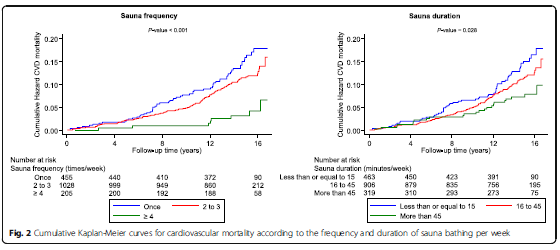
The most cited piece of sauna research is the Kuopio Ischemic Heart Disease Risk Factor Study, led by Dr. Jari Laukkanen at the University of Eastern Finland, published in JAMA Internal Medicine in 2015. Researchers followed 2,315 middle-aged men for a median of nearly 21 years, tracking how often they used the sauna and what happened to their hearts over the following two decades.
The men who used the sauna four to seven times a week, compared to those who used it once a week, had:
A 63% lower risk of sudden cardiac death
A 50% lower risk of fatal cardiovascular disease
A 48% lower risk of fatal coronary heart disease
This wasn't a one-time measurement. It was two decades of tracking the same people, controlling for the usual suspects: age, weight, blood pressure, cholesterol, smoking, activity level, income. The relationship held. More frequent sauna use, less cardiovascular death, in a dose-dependent pattern that researchers could trace directly.
The mechanism makes sense once you see it. Heat exposure raises heart rate and cardiac output in a way that resembles moderate exercise. Regular sessions appear to improve blood vessel flexibility, lower blood pressure over time, and shift the autonomic nervous system toward better balance between its "go" and "rest" modes. None of that shows up after one sauna. It shows up after years of them.
The mind: connection, not just heat
The second study is a different piece of research entirely, done on a different timescale. Published in 2026 in Social Science & Medicine, it was led by Dr. Martha Newson (University of Greenwich) and Rachael McGrath (The London Interdisciplinary School), drawing on 1,907 sauna users in the UK across three linked studies, most through Community Sauna Baths in London. It isn't a 20-year study. Two of the three studies tracked participants over shorter periods to see how wellbeing changed with use; the third took a single cross-sectional snapshot of a larger group to test how sauna identity and ritual related to self-reported wellbeing. Its strength comes from a different place than the Finnish research: a large sample, replicated across three separate studies, rather than decades of tracking.
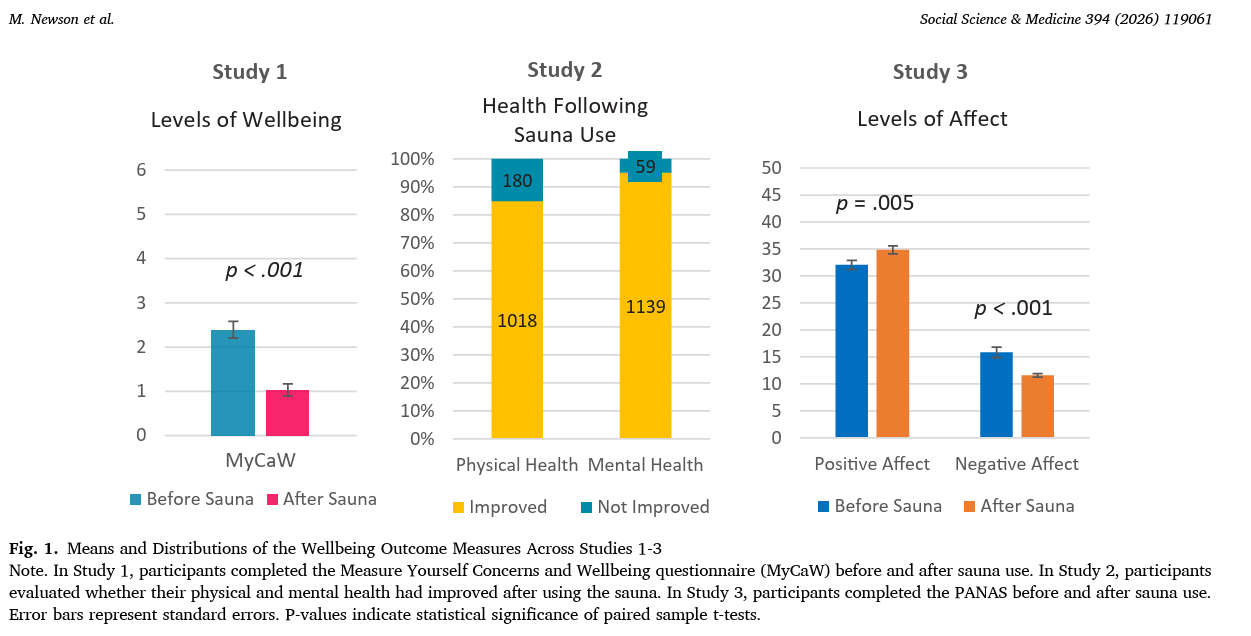
The question it asked was also different: what's actually driving the mental health benefit people report from sauna?
The answer wasn't just heat. It was ritual and belonging. People who went weekly reported a significantly stronger sense of belonging than infrequent visitors; monthly visitors showed only a small, statistically non-significant bump. That sense of belonging, in turn, was significantly linked to better physical and mental wellbeing. Feeling emotional synchrony with others in the room, and experiencing the visit as a ritual rather than a routine, were the specific factors tied to a stronger sauna identity, and that identity is what carried the wellbeing benefit.
That distinction matters for how sauna gets sold in North America right now. The recovery framing treats the sauna as a piece of equipment: you go in alone, you sweat, you leave. This research suggests the room itself, the strangers on the bench next to you, the repetition of showing up, is doing real psychological work that a private infrared cabinet at home can't replicate.
Why these two studies are worth taking seriously
The two pieces of research earn their credibility differently, and it's worth being precise about that rather than flattening them into one story. The cardiovascular findings required following the same 2,315 men for over 20 years, because heart disease takes decades to develop and there's no way to shortcut that with a short trial. The wellbeing findings didn't need two decades: they needed nearly 1,900 people, studied through three separate designs, so that a self-reported feeling like "belonging" could be tested and replicated rather than taken on faith from a small, enthusiastic sample.
Compare either of those to how most "recovery" claims get made. A product study with 20 participants, no control group, and a four-week window doesn't tell you much about long-term health. It tells you what happened over four weeks to twenty people, which is a start, not a conclusion.
The sauna's actual evidence base looks nothing like that. One study is patient in time. The other is patient in scale. Both took the kind of work that a marketing claim usually skips.
What this means for how you use it
The research points toward frequency over intensity. The cardiovascular protection scaled with how often people went, not how hot the room was or how long they stayed. The sense of belonging tied to mental wellbeing scaled the same way, weekly visits mattering in a way monthly ones didn't.
That's a different proposition than "sauna as recovery tool." It's closer to what it's always been: a place you return to, regularly, with other people, over a long enough time that the benefits become measurable instead of anecdotal.
Sources: Laukkanen T, Khan H, Zaccardi F, Laukkanen JA. "Association Between Sauna Bathing and Fatal Cardiovascular and All-Cause Mortality Events." JAMA Internal Medicine, 2015. Newson M, McGrath R, et al. "Sauna culture improves physical and mental wellbeing in the UK through social connection and ritual." Social Science & Medicine, 2026.